
Download the template.
Editable Word document with a one-page staff summary and an acknowledgement form. Aligned with ISO/IEC 42001, the NIST AI RMF and the EU AI Act.
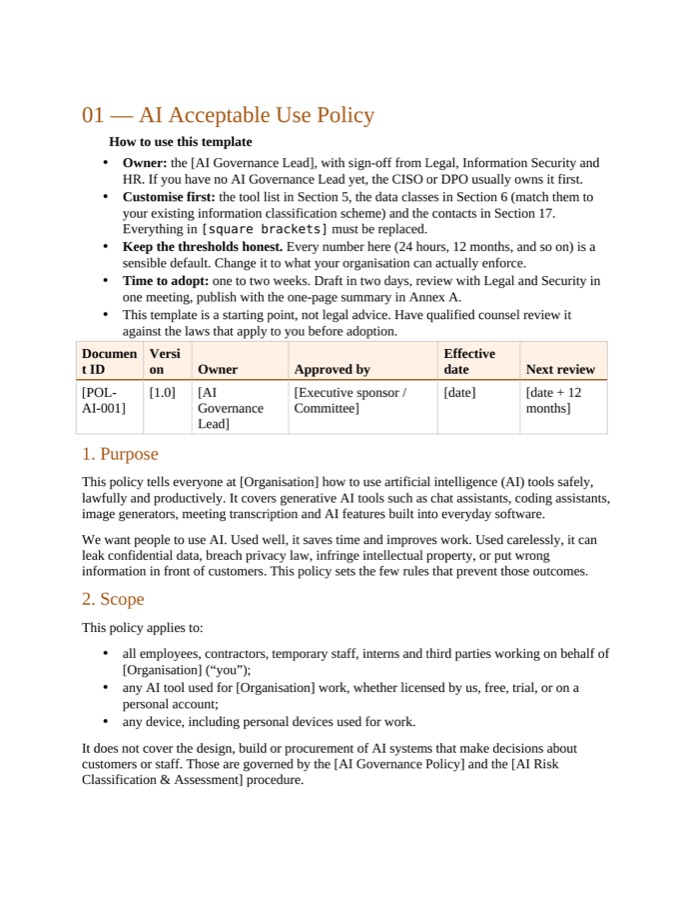
Your staff are already pasting work into ChatGPT, Claude and Copilot. An AI acceptable use policy tells them which tools they can use, what must never go into a prompt, and what to do when something goes wrong. This free template gets you there in an afternoon.
Editable Word document with a one-page staff summary and an acknowledgement form. Aligned with ISO/IEC 42001, the NIST AI RMF and the EU AI Act.
A policy staff actually follow is short at the front and specific at the back. The template has twenty sections, but most people only need to read the first four and the one-page summary. The rest is there for the questions that come up later.
If staff remember nothing else, they should remember these. They open the template and form the one-page summary.
Rule 6 is the one most policies leave out. If people expect to be punished, the leak you most need to know about is the one nobody reports.
Banning every AI tool rarely stops the work. It moves to phones and personal accounts, where you have no contract, no logs and no retention terms. Tiers give people a route they can follow.
| Tier | What it means | Data allowed |
|---|---|---|
| A · Enterprise | Contracted, single sign-on, no training on your data, logging on, data residency agreed. | Public, internal and confidential. Personal data only for uses listed in an approved register. |
| B · Limited | Reviewed and allowed for low-risk use. The vendor may keep what you enter. | Public only. |
| C · Not approved | Anything not in A or B, including free consumer chat accounts and unknown browser extensions. | None. Not for work. |
Two rules make the tiers work. A tool not on the list is Tier C until IT says otherwise. And a new AI feature switched on inside an approved product, like a fresh "summarise" button, isn't automatically Tier A.
Whatever the tool, some data stays out unless a specific system has been assessed and approved for it:
Before pasting anything, minimise it. "Summarise this complaint" works just as well with the customer's name replaced by "Customer A".
The acceptable use policy is template 01 of the AI Governance Starter Kit: 12 editable templates covering governance policy, AI inventory, risk classification, impact assessment, vendor due diligence, incident response and a 90-day roadmap. From €49.
Writing the policy is the short part. These articles cover what comes after it: enforcing it, what governance costs, privacy, training and who to put in charge.
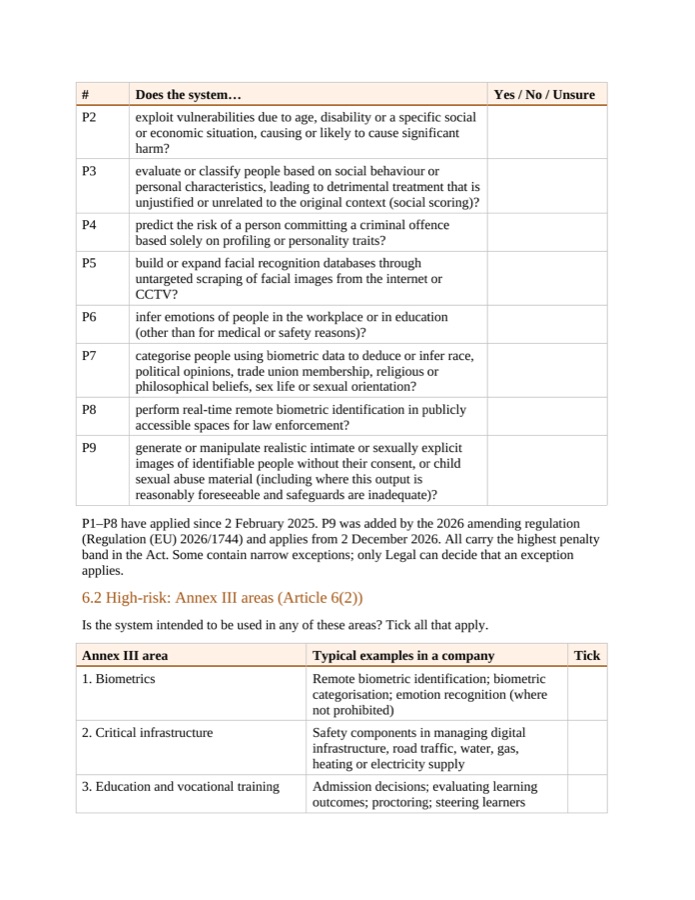
This template is a practical starting point, not legal advice. Have qualified counsel review it against the laws that apply to you before adoption.
Yes. It's a free download in editable Word format. You enter an email address on the checkout page so the file can be sent to you.
An acceptable use policy tells staff how they may use AI tools day to day. A governance policy sets how the organisation decides which AI systems to build or buy, who approves them and how risk is assessed. Most organisations need the acceptable use policy first, because staff are already using the tools.
Yes. A ban without a policy usually moves use onto personal phones and accounts, where the organisation has no contract, no logs and no retention terms. A tiered policy that names approved tools and the data allowed in each gives you control instead.
Not by that name. Article 4 asks organisations that use AI to take measures to support AI literacy among their staff (as amended in 2026). A clear acceptable use policy plus short training is the most direct way to show that. ISO/IEC 42001 also expects a documented AI policy. Confirm your own obligations with counsel.
At least every 12 months, and whenever you approve a new category of tool, such as AI agents that can act on your systems. Keep the approved-tool list on your intranet so it can change without reissuing the policy.
The AI readiness and governance sprint puts the policy and the programme around it in place in three weeks. You end with a governance model, a ranked roadmap and one agent in production.